Dakar Diary-10
 Stage 11 wasn’t really a stage at all. I mean, it was a stage but it only consisted of a liaison to break up the otherwise ridiculously long liaison from Nema to Kayes. They had us down for 372km, 225miles, but with the new schedule we would run 250km that day and the rest the following day. Everyone was looking forward to the little break.
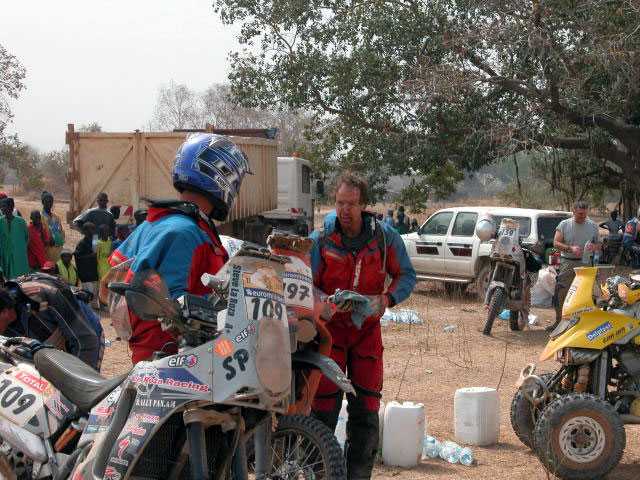
All the support vehicles had to be out early that day or else get stuck in the bivouac for 5 hours. The first bikes weren’t allowed to leave until 11:30 so that put us out around 12:15 I think. That would have been great if there was a place to hang out but with the place cleared out and the addition of two days worth of trash from being in one place it made for an absolute disaster area.
I got back from breakfast to see our entire camp broken down. We thought one vehicle was going to leave early and one stay back so we could relax for a little while. The only problem with that was the airplane boxes. They needed to be packed up and ready to go at 6 and over to the plane by 630. Gary had already started breaking down my camp and left all my riding gear out for me upon my return. He literally did everything, tent and all. I passed the truck with Gary and Jim and Charlie in it about halfway back from breakfast and they informed me of the change in plans. They informed me that they needed to leave RIGHT NOW and all my stuff was back where we were. Without any way to carry gear I had to lose everything I had on my body and get dressed back at the bike. I took off my shoes, socks, jacket and pants and left them in the truck and walked to where my bike was in my underwear and t-shirt. No big deal really it was still pitch black out. I sat there in the dirt field with only my bike, gear and a few locals scavenging for stuff. They didn’t mess with me at all but were just looking for anything that might be left behind that they could use.
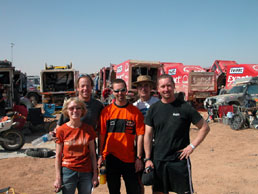 It was actually very peaceful in the morning. Most of the support vehicles had left so there wasn’t much noise but the amount of crap everywhere was unbelievable. Since the bikes are typically the first out I never got a chance to see the aftermath of the bivouac but today I saw it all. The sun came up and once again we were back at the catering tent to hang out for another 4 hours. I drank about as much coffee as I could stand, which is saying a lot, and had nothing else to do but wait. The winds had begun to really kick up and make a mess out of the place. Having been there for over 2 days the Dakar circus really left its mark on Nema. One side of the bivouac was open so it didn’t do a bit of good as a shelter. Every single biker gathered on the other side for any bit of protection from the windstorms. By this point I guess there were probably still 150 people in so the quarters were pretty tight. Nobody was safe. Everyone was wearing goggles and bandannas over their mouth for any sort of help with the sand. We were literally all sitting in a big pile of swirling trash. The nature of the layout created these huge vortices of trash comprised of coffee stirrers, cracker packages, sand, bread, sugar packs and more sand. Just sitting there waiting on our leave time we were forced to sit in trash for hours and if you sat in any one place for too long you would create all these tiny little sand dunes around any pieces of your body that were touching the ground. It was actually a great lesson in dune formation but one that I could have done without. At one point I was sitting there talking with a Romanian competitor that is responsible for organizing the Red Bull Romaniacs. He went on and on about how amazing the event is and I looked over to see what all the photographers were shooting. Chris Blais, Steve Laroza and Casey McCoy were all laying down trying to get some rest. They each had on goggles and a bandanna and were laying in a row of three like the “See no evil” monkeys. The wind had created a little swirling trash tornado over the top of all three of them and they were gathering sand just by being still. I think we all got a little chuckle out of it and for a brief moment I just looked around at the situation and tried to see the humor in it all.
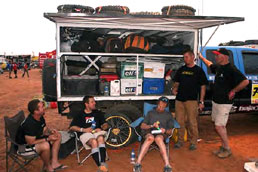 12:15 finally came and we got on the road. The landscapes were amazing. It was all asphalt up to the end but it took us through fishing villages, tiny communities and herds of animals I have never seen in Colorado. There were goats everywhere, tons of camels and donkeys for days towing everything from bicycles to Ford truck beds. Even though we were only on a liaison there was still a healthy dose of caution in the air. If it wasn’t the potholed roads that got you it was a bloated cow on the shoulder that had clearly been sitting there rotting for days. I have never smelled anything so grotesque as a rotting bloated cow.
Ayoun El Atrous was a makeshift bivouac so it was a little short on accommodations, even more so than the others. The last 15km was in the dirt so despite no racing conditions we still arrived dirty and a little gnarly. Robb and Charlie already had the Rally Panam camp set up so getting settled in wasn’t much of a deal at all. I don’t know that we did much that night. I think the bike was still in decent shape, all things considered, but checked it all out anyway. Fresh air filter, check chain and sprockets, check the water which, by the way, never used a single drop, tie about 30 more zip ties around the front subframe, you know, the usual.
We had 4 stages left in the rally but the last one wasn’t really a race. The following day into Kayes meant we would be leaving Mauritania behind for good and we would enter Mali. I don’t think there were any tears shed that night. For the most part, the sections of Mauritania the race had seen were not the most exciting riding I have ever done. It was dirty everywhere, the people were extremely poor and I never got the sense that we were welcome anywhere. The villages, although not hostile at all, didn’t seem like the places I would like to hang out on my next motorcycle journey. I was ready to leave.
Stage 12-Ayon El Atrous -> Kayes
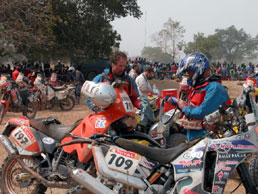 Stage 12 was another 100km or so of liaison and 257km of Special. The roadbook promised more savannah, vegetation and dense narrow routes. I think we were all getting excited about the course changes. Navigation was going to be much more of an issue the farther south we got. There were places in the notes that showed 6 or 7 roads all coming together at one time and you had to find the right one with the compass heading. This could be fun I thought. Traditionally the stages in Mali and Senagal have a reputation for shaking things up in the standings. It is not uncommon for people to throw it all away on one of the last few days and this year would be no exception.
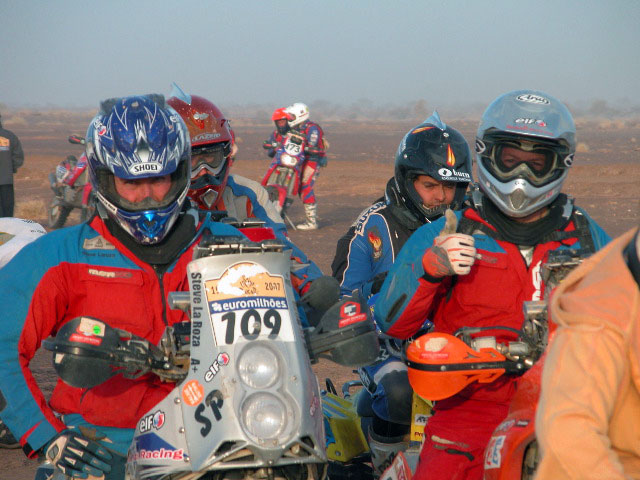
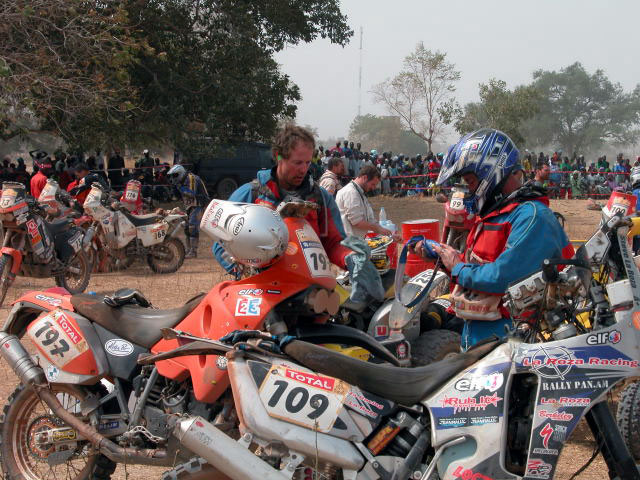
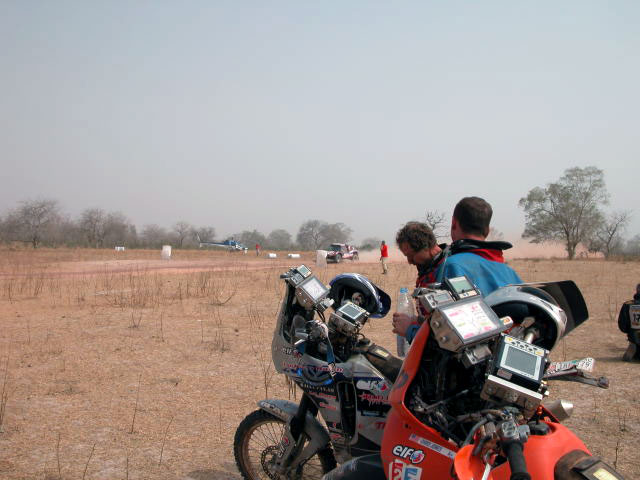
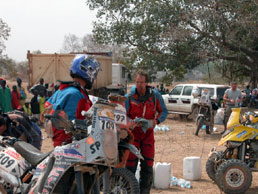
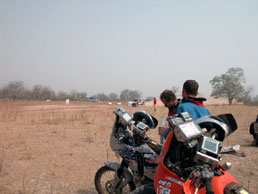
The start of the Special was a little different than some of the rest. With some time to spare we sat still for a few minutes and checked out the bikes. This one was right off the highway so we were joined by a number of moto-spectators. There were a number of BMWs, KTMs and a few Suzuki V-Stroms. Whoever rode all the way down here to see a Dakar stage was a hearty traveler. I have to assume there were a number of Germans in that group. They’re an adventurous bunch.
The landscape had taken on a distinctly different look than the previous stages. The dunes were gone and in their place we now had huge baobab trees. They are the stuff of legends and centuries old. We saw more and more water along the way and with it came bustling villages full of colorfully dressed women and cheering young kids. In every village they had a system of safety people along the route to keep all the children back out of the way. The very strict speed limits made it a challenge to keep the bike upright in the deep sand but it also allowed us some slow time to really take in the local sights. The safety people blew whistles and held up stop signs along the roads to alert everyone of coming vehicles. There have been a number of fatalities through villages in the past and in an effort to eliminate those and other accidents the organization had made great strides in safety awareness. They distribute “comic books” with cartoon-like figures demonstrating the dangers of the coming race weeks ahead of time. I was amazed at the efficiency and effectiveness of these safety personnel. The race could not go on without them.
The course was exactly as the roadbook warned, twisty and tricky. Steve and I stayed together as much we could and in our path left a large dusty wake. The dust was some of the worst we had seen up to that point. With the added forests and greenery the dust had no place to go even with a little breeze. The dirt was so light it would just hang in the air for what seemed like hours. Occasionally the forest would break and we would be surrounded by waist-high savannah grass. The tracks would wind up and down and around the trees like nothing we had seen before. We tried to follow tracks at times but, like the wide open spaces of the week before, you had to constantly confirm the compass and roadbook.
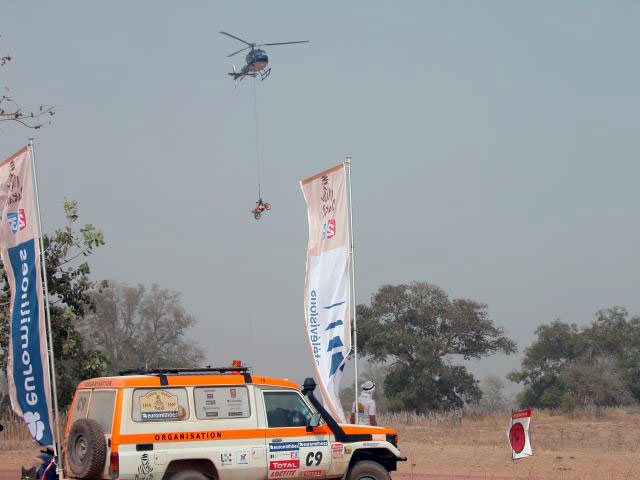
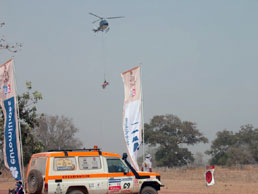
 One time in particular Steve and I got caught out in the middle of nowhere following a group of about 5 or 6 guys. One by one they would peel off on their own and look for another route or follow another heading. This was one of those occasions where your head starts playing navigation tricks on you. I knew we were going the wrong way and I think Steve did too but for some reason you put your faith in the guy out front and hope that he knows something you don’t. This turned out to be the wrong choice. We rode for 5 or 6 or 10km following others and suddenly we were out by ourselves without a track in sight. We both stopped and looked at each other and then at the roadbook and at the surroundings but saw nothing. We killed the motors hoping we could hear someone off in the distance but again nothing. We were completely lost without a single reference to go on and no idea at what point we got off the course. We both had opposite ideas of where we needed to be so we opted for the easiest way out, to backtrack. We thought we’d just keep going back until we had a definite confirmed point either on the roadbook or gps. We turned and slowly got in the exact tracks we just made and proceeded back where we came from all the while looking for other vehicles or dust or something. One by one there was a bike that would just appear out of the savannah and join in our group clearly as lost as we were. One would come from the left, another three from the right and pretty soon we were a group of about 10 or 15 bikes rolling along aimlessly searching for the route in the deep grasses of the savannah. About that time a helicopter popped up out of nowhere as if to answer a call. He headed straight to us and about 100 ft off the ground did a 180 in the air. We all just sort of looked at each other and one by one fell in behind the chopper and set off across the landscape. This went on for probably 5km still without a reference of any kind and suddenly the waypoint popped up in the gps. The arrow was pointing directly straight ahead where a village was supposed to be but without tracks it could be a nightmare to get there. Out of options all of us continued behind and almost out of thin air we came up on the village, our first confirmation in a long time. The chopper was way ahead by now so he did another 180 and hovered over the village for a few seconds. Like the Mother Ship in Close Encounters he flashed his lights as if to say ”You have arrived, now go” and peeled off into the distance. Suddenly it was on again, we were racing. I thought that was about the coolest thing ever to have a helicopter come out of nowhere and show us the way. Someone back at the organization must have seen 15 bikes on the Iritrack getting way off course and decided it was better to get us back right away then try to retrieve us one by one in the dark. That moment was a huge sense of comfort knowing that no matter how lost you may think you are there is always someone that knows where you. There were a number of times during the next few days we were hoping and looking for the helicopter but that was the only time he showed up.
 The dust and navigation really made for a tough one. I was glad to hear at the end of the day that a lot of the pros got lost as well. I recently saw some footage of the race and it reminded me of how crazy some of the trails were that day. On more than one occasion there were 8 or 10 bikes riding around in circles looking for a point or confirmation. I am glad we weren’t the only ones.
We reached Mali and made it in that day. At some point I broke my exhaust and rode the last 25 km with it hanging down and rubbing against the rear tire. I had no idea until we got to the bivouac and Steve pointed it out to me. It was a flimsy design and surprised me that it lasted as long as it did. When we were still in Atlanta Elmer pointed it out to me and told me it was going to break and that we needed to make up some brackets for it. Luckily, we did but never found the time to put them in. Gary, being the metal go-to-guy in my pits looked at it and made quick work of the repair. He cut and drilled and ground it just perfectly and in no time my exhaust was back better than before.
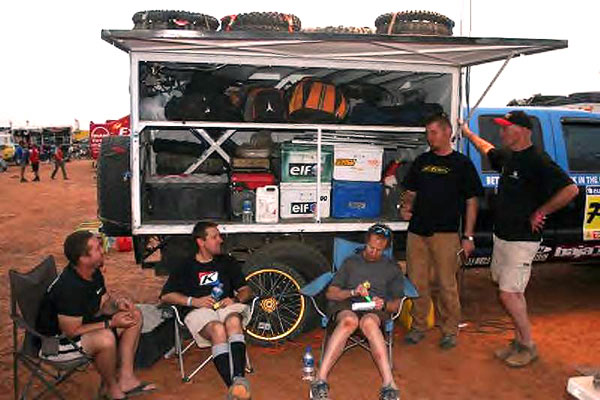
With the stages getting a little shorter each day I found myself with more free time in the bivouac. My kit was getting more and more disorganized each day despite the almost daily cleaning. I had quit folding up the tent each morning and the sleeping bag was more of a pad than anything else. My morning routine consisted of pretty much just jamming it all in at the last minute and sitting on the top to close it. I had a plastic container in the airplane box that was home for all my nutritional supplements and the two powder containers were almost empty. My gel and bar budget was almost right on even with the extras I had tossed to Steve and Duct Tape.
The people around the bivouacs were noticeably more brazen with their attempts to get inside. I was warned ahead off time to not leave a single thing out even when you go to bed. We were surrounded by a 15ft high cement wall all around and then razor wire on top of that. Every once in a while you would see a little head pop over the top and whisper in French for a gift, cadeau. They couldn’t make a spectacle of it or risk getting the crap beat out of them by the cops. The prospect of even just a little something from the rally was enough to try though.
 Kayes to Tambacounda was Stage 13. The route was only 260km but when they handed us the roadbook I thought it was for three days riding it was so big. With millions of turns, cautions and speed zones the next day would be a busy one. I noticed myself spending less and less time on preparing my roadbook each night. I don’t know if it was a comfort level I had reached with all the cautions or what but I felt like I was sort of figuring it out a little. I don’t know that my navigation was a lot better than before I started but I really felt like I was figuring out the roadbook and whoever made them. They would always err on the side of caution and as a result the book was filled with at times way too much information. I got to the point where the cautions with only one ! were hardly even notated unless they were followed by another instruction but when you saw a !! or !!! you could potentially be in for something big. Even the turns and and changes in direction were starting to make more sense. The illustrations in the center of the book believe it or not were almost exactly like the road they were written after. If you just took the time to look and read what was written then the navigation was easy. Only when you are racing along at speed and trying to digest all the navigation tools at once does it become a real task. The real artists can manage everything at once while I tool along and run over bushes and into trees.
13 was hard and even more dusty than the day before and the bike would take a beating.
— Chris
[< back to main race reports page]